
Portable Stimulus (PSS) Guide 2026: Working Examples and How AI Helps
Learn Portable Stimulus (PSS) with runnable DMA and UART examples, what is new in PSS 3.0, and how AI tools help write PSS models. Explained in plain words.
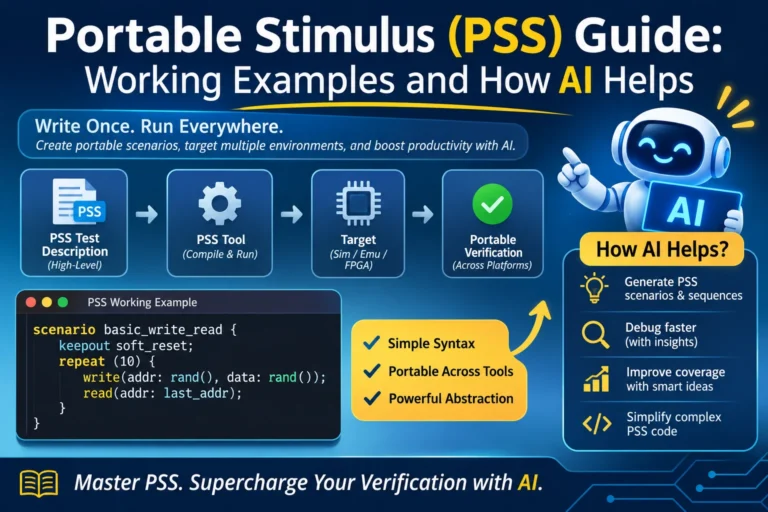
Learn Portable Stimulus (PSS) with runnable DMA and UART examples, what is new in PSS 3.0, and how AI tools help write PSS models. Explained in plain words.
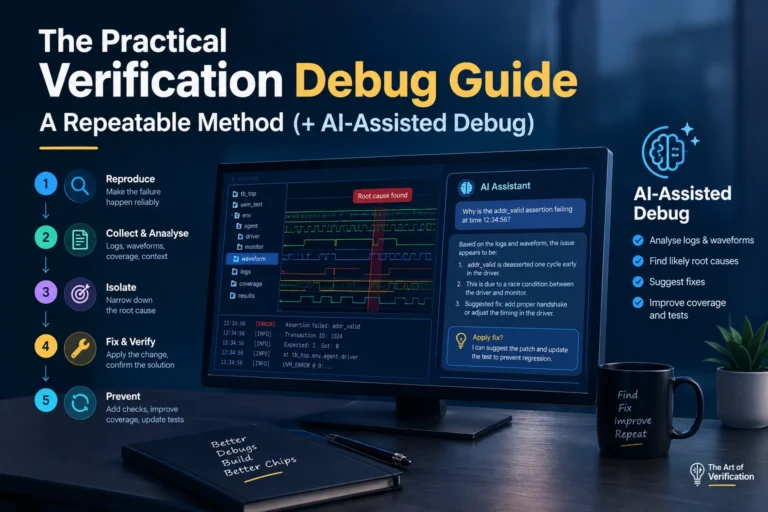
A repeatable verification debug method: the five-door order, UVM and SystemVerilog tips, waveform tracing, regression triage, and an AI-assisted debug flow.

In short: AI-assisted verification uses machine learning and large language models to speed up the slow, repetitive parts of chip verification. Your value as a verification engineer is moving toward building and owning that checker. Introduction and why this matters now Verification already takes the biggest share of an SoC schedule. Designs keep growing faster…

In the fast-moving business of chip design, where logic and silicon come together to power the devices we rely on every day, a group of quiet problem solvers does the careful work behind the scenes: ASIC verification engineers. These are the people who chase down bugs before a chip ever reaches production, testing every path…

In short: Designs need many clock frequencies from one reference. Division is simple but only gives integer ratios below the reference and can pile up jitter across a long chain. Multiplication, usually via a PLL, reaches higher frequencies, supports non-integer ratios, and often has lower jitter, which is why it suits high-speed links, CPU cores,…

In short: Formal and functional verification are partners. Formal uses mathematics to prove a property holds for every possible case, which fits small control logic and safety-critical corners. Functional runs simulations across many realistic scenarios and scales to a full system, but it can only sample the state space. Strong teams use formal for the…

In short: A verification plan is the map for the whole effort. It lists every feature to check, ranks them by risk, matches each to the right stimulus and technique, and ties coverage goals and a schedule to them so problems appear early. Read the spec first, blend random, directed, and environment-driven stimulus, track coverage…

In short: Debugging carries a scientific name, but the toughest failures are cracked by judgment, not formulas. You follow clues like a detective, lean on experience to sense where a bug hides, invent unplanned stress cases, and talk the problem through with your team. The rigorous side confirms a cause; the artistic side is what…

In short: Good verification is less about tools and more about how you think. Five habits carry most of the weight: thinking strategically about the whole system, reading the design the way its author did, inventing test cases that push past the happy path, choosing the right method for each job, and sharing what you…

In short: Coverage-driven verification checks that the planned behavior works. Stress verification pushes the design past its comfort zone with heavy, back-to-back, and unexpected traffic to see where it bends or breaks. It finds corner cases and bottlenecks that ordinary tests miss, so the chip holds up in the messy real world, not just in…