
The Stages of IP Verification: From Plan to Sign-Off (With a UVM Example)
Sanity, feature, closure, regression, sign-off: each stage of IP verification finds bugs the others miss. See it happen on a real arbiter IP and UVM bench.
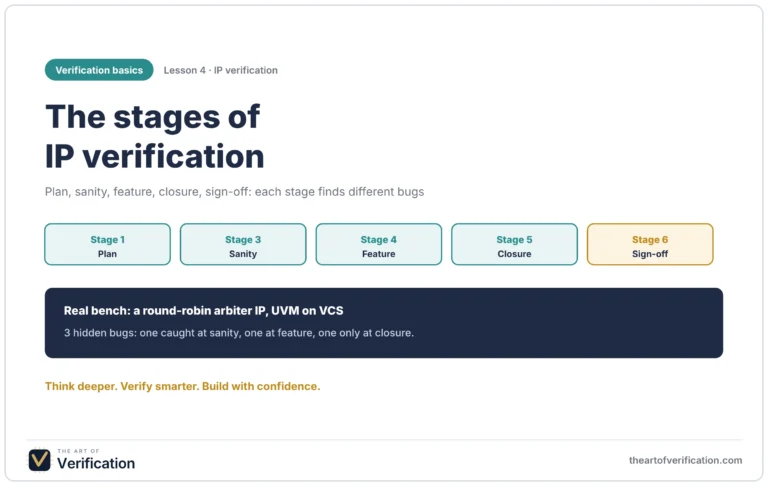
Sanity, feature, closure, regression, sign-off: each stage of IP verification finds bugs the others miss. See it happen on a real arbiter IP and UVM bench.

In short: An interrupt is a sideband signal from a design block that says “something needs attention now”. In a UVM testbench you model interrupt handling by watching the interrupt lines and, when one fires, starting an interrupt service routine (ISR) sequence that uses grab() to take exclusive control of the sequencer. The ISR clears…

In short: A virtual interface is a handle that lets your class-based UVM code reach a real, static interface connected to the DUT. You pass it in with uvm_config_db#(virtual my_if)::set from the top module, then each component reads it with get in build_phase. This keeps the run-time class world and the static module world connected…

In short: A clock monitor is a reusable SystemVerilog/UVM component that watches a clock signal and automatically checks its frequency, duty cycle, and on-the-fly switching, and flags glitches or timeouts. Because it is built as a uvm_monitor inside a uvm_agent, you can plug it into any UVM environment and verify complex clock systems without writing…
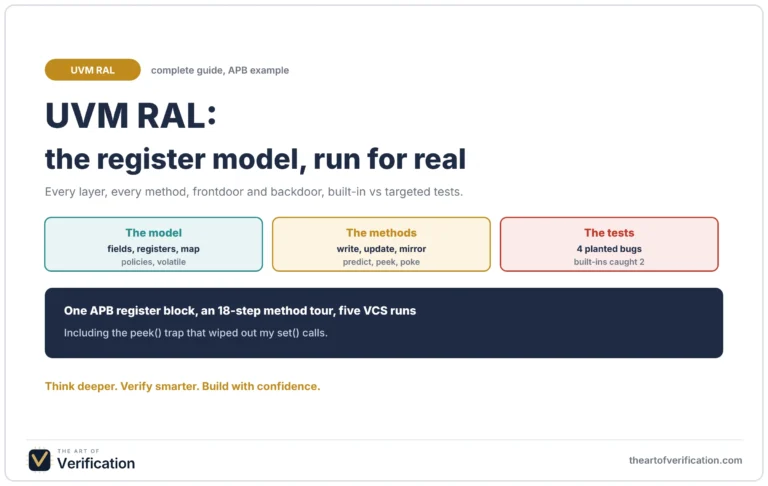
A complete UVM RAL guide on one APB register block. Fields, registers, register files, maps and sub-maps as real code, every method run on Synopsys VCS, and 4 planted bugs that show what the built-in sequences catch and what they miss.
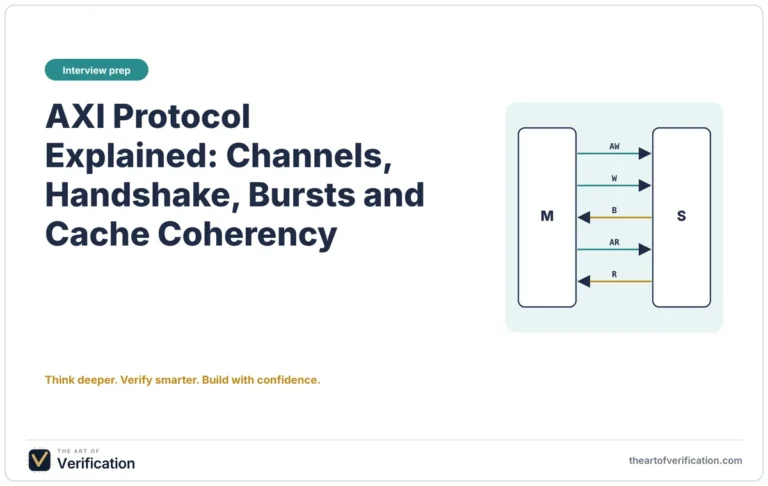
In short: AXI (Advanced eXtensible Interface) is Arm’s on-chip bus for connecting masters like CPUs and DMA engines to memories and peripherals. It splits every transfer into five independent channels: write address, write data, write response, read address and read data. Each channel moves a beat only when VALID and READY are both high. Bursts…
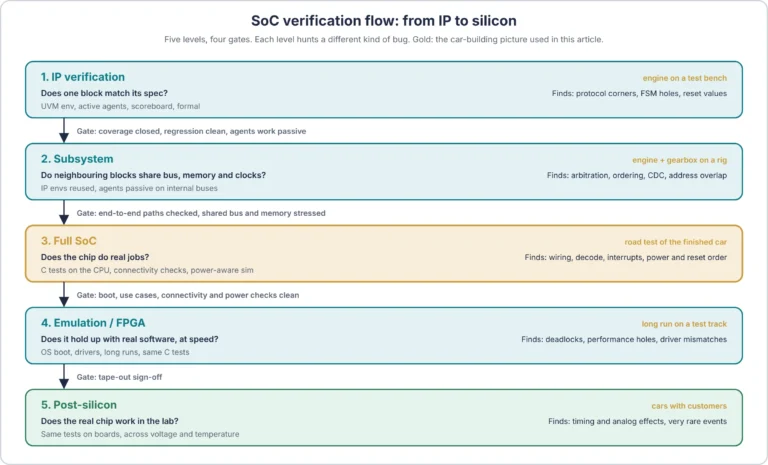
In short: The SoC verification flow is how a team proves a chip works, one level at a time. Each IP block is verified alone, then small groups of blocks (subsystems), then the full chip with the real CPU running test code, then the design runs on an emulator or FPGA, and finally the real…
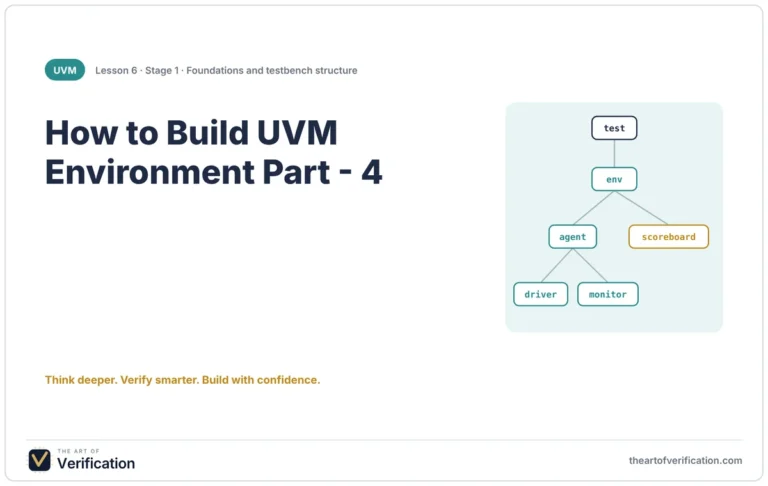
In short: This is the final part of building a UVM environment for the pipe design. Here we add the test, pass the real interface down to every component through the configuration database, add a coverage collector, build the top module that ties the design to the testbench, and finally run the first simulation. By…
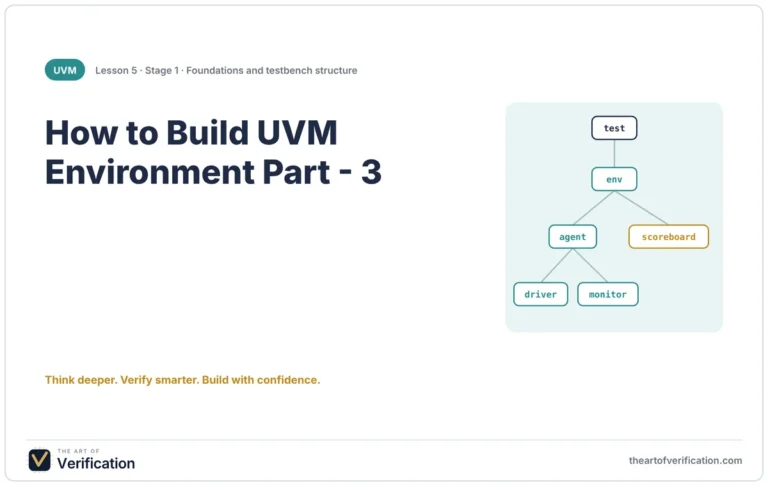
In short: This is part three of building a UVM environment for the pipe design. Here we add the monitor that watches the pins, wrap the driver, sequencer, and monitor into an agent, and build a scoreboard that checks the results against a small reference model. We then group everything into an environment. After this…
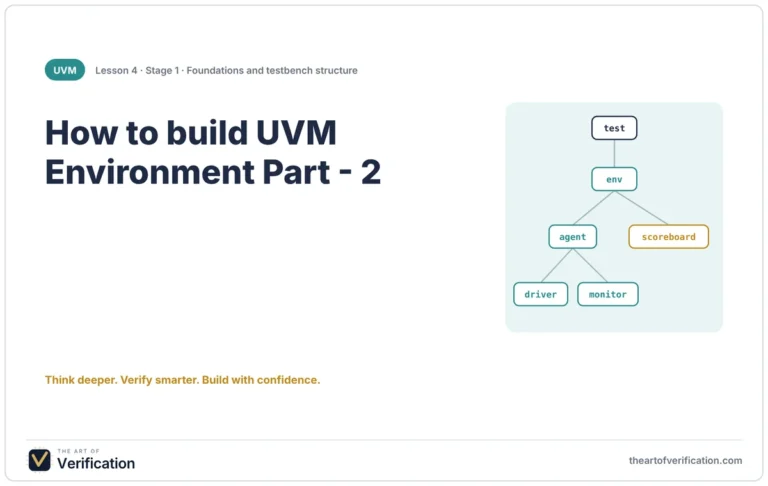
In short: This is part two of building a full UVM environment for the pipe design. Here we finish the driver so it actually wiggles the pins, add the sequencer, and write several sequences: a single packet, many packets, and a directed case. We also explain the handshake between a sequence and the driver, so…